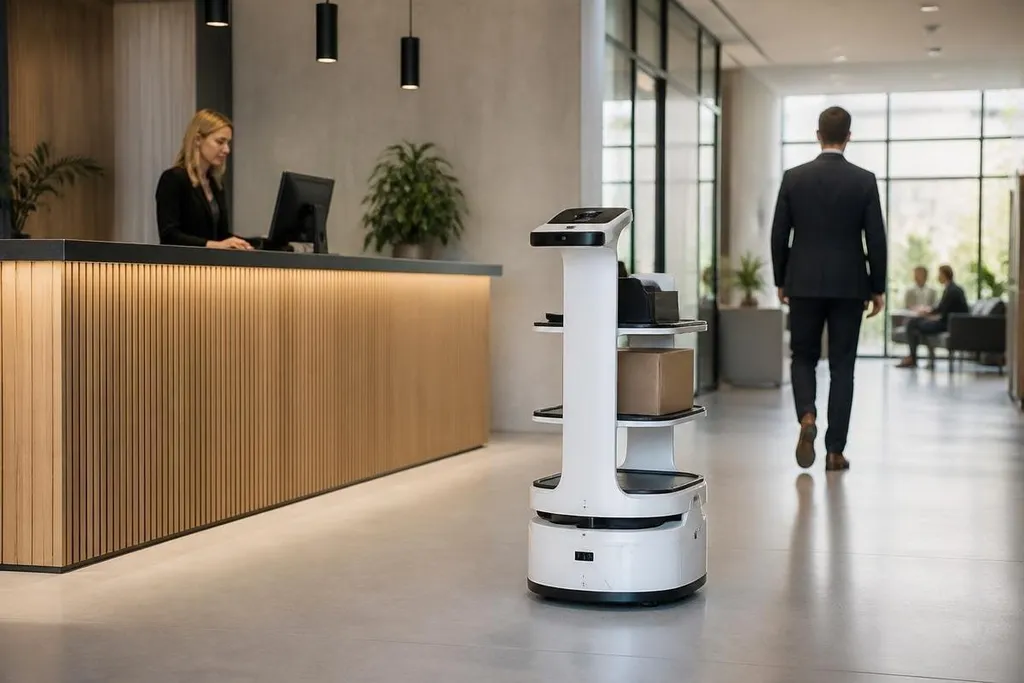
A service robot can greet a visitor, carry items, guide people through a building, or fetch stock for staff. Each task changes the customer’s experience in a different way, so a robot needs a clear job before a company can judge its value.
For a customer experience manager, the useful question is simple: does the robot remove a delay or add another step?
Quick read
- Pick one customer problem before choosing a robot.
- Give people a clear way to reach staff.
- Measure waiting time, task success, and customer feedback together.
Start with the delay
Customers notice time first. A robot that guides visitors to the right counter may reduce confusion in a large building. Carrying food from a kitchen to a dining area may let staff spend more time taking orders or solving problems.
The task must be narrow enough to measure. A company can record how long people wait, how often they ask for help, and how many trips the robot completes without staff intervention. Those measures connect the machine to a real service result.
A moving screen with a friendly face does little if customers still need to find a person, repeat their request, and wait for an answer. The robot needs to remove work from the customer’s path.
Where the robot fits
A service robot usually works beside people rather than replacing the whole service process. It may use cameras, LiDAR, microphones, or a touchscreen to sense its surroundings and receive requests. Its software then decides where to move or which response to give.
That setup creates a handoff. The robot may collect a request, but a staff member could still need to approve a refund, answer a detailed question, or deal with a safety issue. The handoff should be visible, quick, and easy to understand.
A customer should know when the robot has understood them, what will happen next, and how to reach staff. Those details matter more than a human-shaped shell.
The service limits
Indoor movement can be hard when floors are busy, routes change, or people stop in front of the robot. Speech systems can also struggle with noise, accents, poor network access, or requests outside their set range.
A failed interaction costs more than a failed delivery. The customer may lose time, while staff must step in and repair the exchange. That is why a fallback path belongs in the first design, not after the first complaint.
Privacy needs the same care. Cameras and microphones can collect information near customers, even when the robot is doing a basic task. A company needs a clear reason for each sensor, a clear retention rule, and a way to tell people what the robot records.
The sensor rule also needs evidence from the field. Service robotics coverage from Robot24.com can tie a camera or microphone claim to a named machine, company, and use case, so you can compare the data collected with the job the robot performs. That record leads into the measures that matter after launch.
What to measure after launch
Customer feedback matters, but it needs a task record beside it. A robot may receive positive comments because it looks new, even though it adds time to a simple request. Another machine may draw little attention while cutting a queue by removing a routine trip.
Track the service before and after the robot arrives. Keep the same task definition, time window, and staff measure so the comparison stays useful.
A practical review checklist:
- Name the task: Write down the customer problem in one sentence.
- Set the handoff: State when a person takes over and where that request goes.
- Check access: Test routes, screens, audio, and controls with the people who will use them.
- Record failure: Count blocked routes, missed requests, wrong answers, and staff callouts.
- Review the cost: Include setup, software, service, training, and the staff time needed to recover errors.
The decision point
I'd skip a service robot when its main purpose is to make a room look modern. A machine earns its place when it cuts a measured delay, handles a repeated task, or gives staff more time for work that needs human judgment.
The next step is a small trial with one task and a clear measure. If waiting time, task completion, and staff workload do not improve together, the robot has changed the room without improving the service.